
EARLIER THIS SPRING I was approached by the alleged conservative student organisation in Norway, FAKS. They kindly asked me to contribute to their magazine, Føniks (Phoenix).
The theme of the upcoming edition was «liberty», and its publication to coincide with the international conference NOSTOS. The intent of NOSTOS is to unite conservatives across Europe (hence me writing in English for the very first time). We shall see how unifying they are in practice in just a short moment.
Politely accepting the invitation, I penned an article with the first thesis that sprang to mind: That if your prime concern is with liberty, you are more of a liberal than a conservative. Worse: If you believe in freedom in a more unlimited sense, as libertarians tend to do, you don’t even qualify as a proper classical liberal, who would grasp that uncurbed freedom has illiberal consequences.
These are rather obvious points to make. It is also exactly what the so-called conservative movement needs to hear more than anything else at this particular moment in time.
Still, in my subsequent correspondence with FAKS, they demanded that I edited out my criticisms of radical market liberalism, foreign interventionism, Ronald Reagan and Margareth Thatcher in particular. Turns out their conference is funded by the UK based think tank New Direction. (Sounds very conservative, doesn’t it? Would make for a nice band name though.) New Direction was founded by the iron lady herself, a giant failure who managed to permanently kill off conservatism in the entire north of England with her sheer arrogance, incompetence and lack of shared interest with the working class.
The message conveyed to me was crystal clear: You must not make our sugar daddy unhappy, you must suck up to the neoliberals and neocons who owns us (who in turn sucks up to major multinational corporations and ultra rich donors, the source of all their wealth to begin with). For anyone who knows me even in the slightest, my reaction should come as no great surprise. I refused to comply. Instead, I doubled down on my criticisms.
So our great defenders against cancel culture went ahead and cancelled the article, deemed too offensive for those who finds absolute liberty the highest value of all.
How else should the strong prey on the weak? That is their core belief after all. It also happens to be the exact opposite of everything the father of modern conservatism, Edmund Burke, stood for. But who cares, right? Modern day «conservatives» least of all, it seems.
FAKS proposed to publish my article elsewhere, safely out of sugar daddy’s dollar eyed sight. I think not, as I find it a tad repugnant to rub shoulders with opportunists of that sort. I won’t attend the NOSTOS conference in Helsinki either, as I have certain principles to attend to instead.
I am sometimes accused of criticising everyone. This misses a crucial point: My position is one of finding the right balance between conflicting values, all of which has some validity. This is safely within the Aristotelian tradition. It is also where the really hard thinking comes in. My issue is with lazy thinking. With ideologues who have found one single value, be it liberty, order or social justice, that they champion to such an extent that they think it nullifies all other considerations.
Unfortunately, our political system is by design dominated by such blockheaded dogmatism, instinctively hostile to any sign of independent thought or an original mix of sincerely held opinions. This is a sad fact, yet it is fact.
Oh well. With no further ado, here’s the cancelled article in question:
The Great Paradox of Freedom
Within the wide walls of absolute liberty, every evil conceivable to man resides.
Under its sky high ceiling dwells drugs, unchecked corporate greed and tiresome oversexualization of the public sphere.
In its boundless Kingdom of Vulgarity, the deep, nuanced conversation of the learned is drowned out in the coarse, shallow noise of the smug comedian, vile activist and chronically unpleasant anti-social media addict.
Where the wild honeysuckle grew, the gas-station now looms large, as Walter Lippman once wrote.
Here family life lies in ruins; the brutalist city landscapes are giant shopping malls rather than social, cultural and spiritual communities; and man is reduced to a mere consumer, drifting purposelessly around in a sea of plastic waste, waiting for his early grave (no doubt hurried on by sugary drinks and processed fast food) to arrive.
The funeral march, we have come to expect, will either be featuring Cardi B or Post Malone, a cause for considerable jealousy among the congregation for the deceased.
Since the land of his remains belongs to everyone, it doesn’t really belong to anyone.
So what is liberty in an absolute sense, truly?
Not much at all, as it turns out. Just as coldness is defined by the absence of hotness, and darkness by the absence of light, unrestrained liberty is, in its essence, the absence of compulsion by external social forces.
To elevate freedom to the overarching principle, it follows, is entirely antithetical to the conservative mindset – which above all places value in moral order and tradition, both very much reliant on authority. What’s more, it’s completely impractical from a straightforward philosophical point of view. Indeed, it will inevitably lead down the path of contradiction, as the freedom of citizen A conflicts with the freedom of citizen B, and vice versa.
The philosopher Thomas Hobbes, who endured the English civil war in the 17th century, famously depicted the state of nature as a hellish place, roamed by a «war of all against all.» As a suiting analogy to his preferred absolute monarch, bringing sweet, peaceful order to the bloody chaos, he evoked the Biblical sea monster of Leviathan. On the surface of it, this was the ultimate trade-off between liberty and security. But Hobbes didn’t really see it as such at the tumultuous time. In fact, he appreciated the (much exaggerated) order brought by the all-powerful ruler as a most necessary condition for «liberty against other men» and «other men against himself.»
Political philosophers of a more liberal inclination, in stark contrast, tend to romanticise the state of nature as something just short of utopia. Well, if that’s really their predicament, they are most welcome to crawl down on all fours and roll around with the swines in the mud. There reigns their holy state of nature, their glorious liberty!
By casting off the shackles of tradition and bringing down the pillars of civilization, man might imagine himself a freed creature. In reality, he has simply replaced the highest aspects of human nature with the lowest instincts of our species, and thereby devolved into yet another beast toiling on the savanna.
As we are rapidly learning in our age of selfism: Where man is not a slave to the tradition of moral self-restraint, he is soon doomed to be enslaved by his animalistic impulses instead.
The Great Paradox of Liberty
With regard to the question of the state of nature, one is perhaps wiser to consult the biologist than the political theorist. In The Origin of Species (1859) Charles Darwin noted that we are the end product of a «war of nature, of famine and death.» Or consider his commentary on the parasitic wasp Ichneumodinæ, delivered in a letter to the prominent American botanist Asa Gray: «I cannot persuade myself that a beneficent and omnipotent God would have designedly created the Ichneumonidæ with the express intention of their feeding within the living bodies of caterpillars.» The cold empirical description of the natural world bears more resemblance to the Lord of the Flies (1954) than to the rosy picture often painted by the liberal thinkers.
In the beating heart of Rousseau’s liberal philosophy lies the maxim of «forcing man to be free», a self-contradiction so serious that the entire thesis of The Social Contract (1762) collapses in on itself.
In The Open Society and Its Enemies (1962) Karl Popper introduces his famous paradox of tolerance, stressing the importance of intolerance towards the intolerant in order to defend our free society. By doing so, he proudly declares himself to be fantastically intolerant, so shouldn’t be lended any tolerance on his own account.
And so it continues. In accordance with John Stuart Mill’s harm principle, no man has the right, as a first principle, to harm another. As a socialist, he seemed simultaneously extremely eager to point the gun of the state towards the skull of his neighbours for a great number of reasons, be it public education or progressive taxation, which makes a mockery of his (rather arbitrary) foundational value in On Liberty (1859).
Or take John Rawl’s colourful suggestion, in his mythical Theory of Justice (1971), to imagine yourself, as in an existential lottery, being allocated to a completely random position in society – the implication being that we are to cherish the freedom of every single member of society. Should you suddenly find yourself in the place of an unborn child, however, Rawls might just have to kill you, rendering his entire argument meaningless. The difficulty lies not in handing out freedom left and right, it seems, but in resolving the unavoidable conflict between the freedom of different individuals, or sets of individuals, in society (in this case, the freedom of the mother versus the freedom of her unborn child). In the end, all liberals, however intricate their theories, must face this glaringly obvious dilemma.
Let me stress: These are not some cherry-picked, peripheral curiosities of the liberal intellectual tradition but some of its key ideas.
In his much cited lecture Two Concepts of liberty (1958), Sir Isaiah Berlin draws a critical distinction between the concept of negative freedom (freedom from state force) and that of positive freedom (freedom to act, often with assistance of state force). Whereas the first is associated with natural rights, the second is closely tied to modern human rights. These two strains of liberty cannot be squared, as positive freedoms demand that the state actively override the negative freedoms of its subjects. It was for this very reason that Berlin railed against the concept of positive freedom, which he rightly found to pose an authoritarian threat.
Even Adam Smith, the father of laissez faire economics, acknowledged on the gripping pages of The Wealth of Nations (1776) that unregulated markets eventually will result in the growth of monopolies and a class of manufacturers who will conspire against the public and their liberties. As the great mind of Smith understood all too well: Uncurbed freedom has illiberal outcomes.
In Plato’s The Republic (375 BCE) Socrates makes the interesting observation that the child of the democrat is destined to become an anarchist, who in turn embodies the soul of a tyrant. At first glance this might seem counterintuitive to the modern reader, but as the anarchist does not recognize any restraints on herself, she has given herself a carte blanche to transgress on the freedoms of others at will.
For reference, just take a quick peek at the works of the Russian anarchist Mikhail Bakunin, which can fairly be dismissed as the ramblings of a homicidal, terroristical maniac. «What is property?» asked his French teacher Pierre-Joseph Proudhon in the title of his book from 1840, answering his own question at once: «Property is robbery!» He thereby committed the greatest thefts of all, by claiming ownership over the entirety of the planet.
In the same manner as Proudhon didn’t accept property rights as a sensible restriction on his own freedom within the nation, the globalists won’t respect national sovereignty as a limit to theirs on the international level. «To me the world is my country,» mused Dante Alighieri in De Monarchia (1313), «as the sea is to the fish.» This is the typical euphemistic power language deployed by the globalist, who cleverly covers his naked imperialism in a cloak of brotherly love for mankind. Dante’s prescription was that freedom is best preserved in a world monarchy. Predictably, the seat of this absolute authority was to be placed in his own nation, his own culture, his own church.
This rings true to this very day, where it’s the young, Western NGO activist who is eagerly fulfilling the promise of the white man’s burden. Unbothered by such small inconveniences as the feelings of the local populations, she thinks it’s her place to force her own social values upon every single nation on earth. Countries that don’t toe the line for her very specific secular variety of human rights (the new universal morality that has replaced Christianity) run the risk of economic strangulation or being bombed into servility.
Another philosopher with a cyclopian obsession with liberty was of course the German nihilist Friedrich Nietzsche. He detested the «slave morality» of Christianity. As an alternative, he believed true freedom to be found in the removal of Christian constraints on the strong Übermensch, so that it could freely trample on the unworthy weak. So the early roots of fascism too can be found in the concept of unlimited freedom.
«Your freedom ends where my nose begins,» it has very wisely been said.
Or as John Locke wrote in his celebrated Two Treatises of Government (1690): «Where there is no law there is no freedom, for liberty is to be free from restraint and violence from others.» Locke understood that liberty and law are deeply intertwined. Their relationship is such, that the former simply cannot properly exist without the latter.
Likewise, Immanuel Kant described civil liberty as the «condition in which nobody is obliged to obey anything else but that which is decreed by law.»
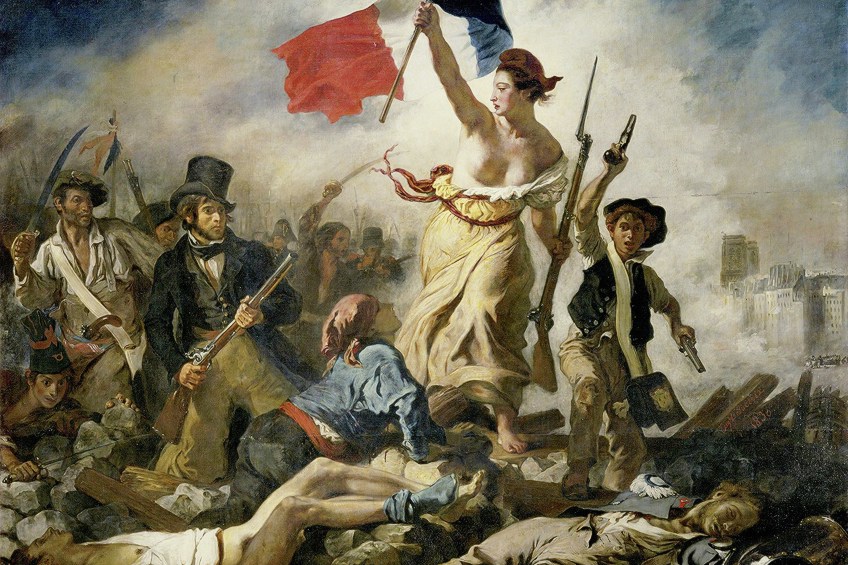
Also Edmund Burke grasped this elementary point. During the French revolution, he confessed in a private letter that the freedom he sought was «that state of things in which liberty is secured by the equality of restraint» (my emphasis). The Jacobins saw it differently. So, in their hopeless search for a new liberal order, they erected a totalitarian terror state on the ruins of the authoritarian monarchy. This is pretty much always the faith of the «restraints for thee, not for me!» liberators, from the Jacobins to the Bolsheviks to the Maoists.
The Circle of Liberty
The natural rights theorists extrapolate from what they refer to as the first rule of nature, namely self-defence. To maximise the negative freedom they champion, one could perhaps imagine each citizen (as well as their properties) surrounded by an impenetrable circle. The subjects might move freely around as they wish, but cannot violate the circles of their neighbours. The only business of the state is to maintain the integrity of these circles. In this picture, there can be no higher social organisation, no complex social order, not even the provision of critical infrastructure by the state, only atomised individuals. Man would certainly never have sat his foot on the moon.
I’m firmly with David Hume on this. There never was such a thing as a social contract, it’s simply an abstraction, «a mere philosophical fiction.» Society, Hume thought, gradually evolved from what had proven successful in social organisation.
We have already touched upon Darwin. Another interesting natural philosopher was the Russian anarcho-communist Pjotr Kropotkin, who detailed the importance of the mechanism of intraspecies cooperation for thriving, sustainable animal communities, a highly fruitful perspective on a primate species like ours. Both The Republic by Plato and Politics by Aristotle traces the origin of the polis to the fact that man by nature is a social animal. It is for this simple yet powerful reason an eternal truth that the well-organised shall inherit the earth – including the political system, the press, the educational system, the cultural institutions and the multinational corporations – not isolated individuals.
[The Italian economist Vilfredo Pareto, who birthed such notable economic concepts as Pareto efficiency and Pareto distribution, wrote that society is always run by the organised few against the interest of the unorganised many.]
Herbert Spencer remarked in his The Man versus the State (1884) that economic individualism had largely been abandoned by liberals and adopted by the conservatives at that point, creating a switch between the two sides. This, I believe, has evidently dealt a devastating blow to the conservative cause in the West.
Whenever the left get their hands on the levers of power, they mobilise the entire apparatus of the state to their ideological ends, moving everything two, five or even ten steps in their preferred direction. Whenever the right obtains the sword of the state, they will refuse to wield it, so everything (at best) stands still.
Fisher Ames resorts to Newtonian physics to drive home the point: «It is indeed a law of politics as of physics, that a body in action must overcome an equal body at rest.»
The obvious end game is that Western conservatives have conserved little, unlike their less individualistic counterparts in the near or far east. At best, they have contributed to the death of tradition by slowly choking it in the invisible hand of the market.
This pretty much explains the drastic leftward shift of the Overton window and our culture in general, especially since the libertarian element, in the anglosphere inspired by Milton Friedman and spearheaded by such figures as Ronald Reagan and Margareth Thatcher, hijacked the conservative movement in the 1980’s. In the process, they pretty much surrendered the entire culture to the liberal left in exchange for privatisation and market reform. The true socially, culturally and morally conservatives have been living in exile ever since, looking outside-in on an emerging socially liberal consensus in the halls of influence and power. Conservatives in the Western world are currently in no position to win on a single social, cultural or moral issue in the long-term, because they have lost their own parties, their own organisations and their own publications.
So my dear fellow conservatives, by all means defend the important freedoms – those of thought, speech and assembly, or property rights, or the rule of law – but do not buy into the fantasy that freedom is the beginning, middle and end of our struggle.
Western civilisation contains so much more than the vacuum of liberty. It’s the happy polygamous marriage of Greek thought, Roman institutionalism and Christian love for thy neighbour, later joined in full union by the principles laid out by the Renaissance, the Reformation, the Enlightenment and, for those who truly holds liberty dear, the English inventions of Magna Carta, Habeas Corpus, the Bill of Rights and parliamentary national democracy.
The proper role of the serious conservative is not only to keep the grass from growing too much – twisting around us and tying us down to the ground till we can barely move – but to preserve all of these beautiful flowers in our lovely garden.



 Olav Drange Moen